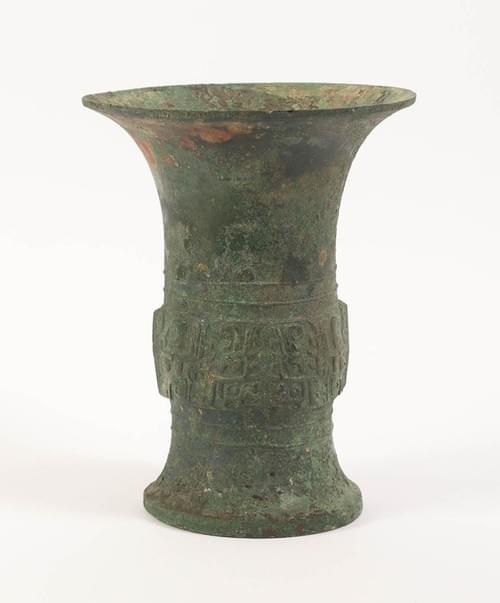
A BRONZE ‘TAOTIE’-DECORATED ZUN
Height: 25 cm
Weight: 2.5 kg
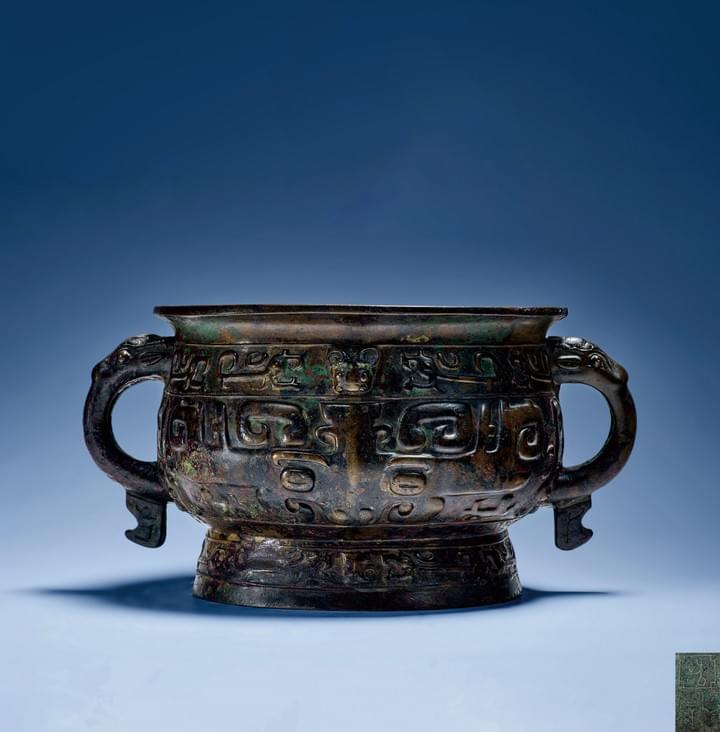
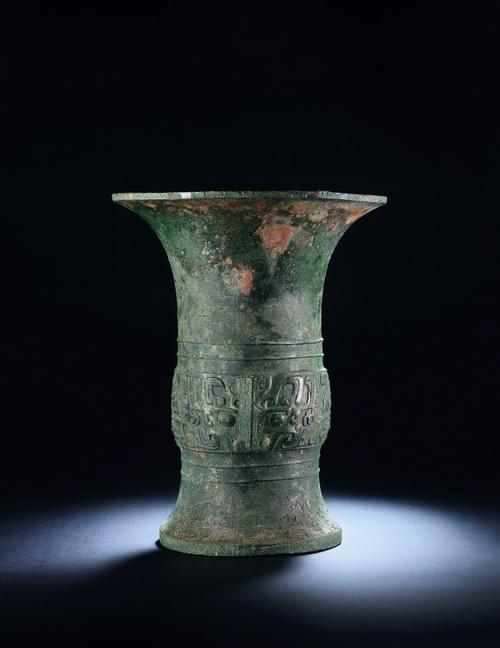
The vessel has a flared mouth, constricted neck, swelling body, and a high ring foot that spreads outward. The abdomen is carved with taotie motifs. The decoration is restrained and composed, and the overall form is archaic and austere in character.
Provenance
Purchased from T. K. Asian Antiquities, New York, circa 2005.
Literature
Celestial Guardians of Ancient China, T. K. Asian Antiquities, January 2000, p. 23.
Description
The vessel is of dignified and architecturally balanced form, the slightly flared mouth rising from a subtly constricted neck to a rounded body set upon a spreading foot. The profile is stable and vertically integrated, displaying the structural clarity characteristic of the late Anyang to early Western Zhou transition.
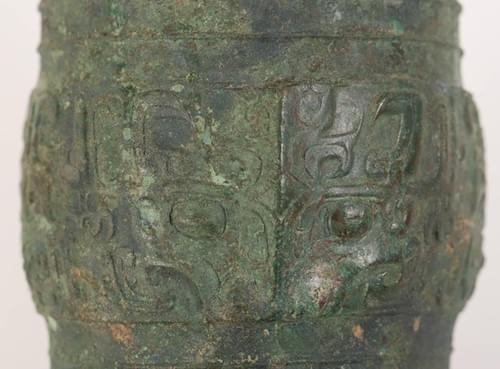
The principal decorative register is cast in relief with confronted taotie masks divided by vertical flanges. The masks are symmetrically composed and less exuberant than late Shang high-relief prototypes, reflecting a stylistic shift toward compositional order. The ground is filled with finely rendered leiwen (thunder-pattern) scrolls, evenly spaced and technically controlled.
The surface treatment is restrained, emphasizing clarity over dramatic modeling. The flanges are cleanly articulated, and the sectional-mold casting demonstrates refined technical control, suggesting production within an established ritual bronze workshop tradition.
Stylistic Analysis
The present vessel exhibits features transitional between the late Shang and early Western Zhou periods:
The continued prominence of taotie masks reflects strong Anyang lineage.
The moderated relief and increased symmetry suggest early Zhou formal discipline.
The proportionally stabilized silhouette — less exaggerated than Shang examples — aligns with early Western Zhou ritual standardization.
While the decorative vocabulary remains Shang-derived, the compositional restraint and structural integration support a dating at the cusp of the dynastic transition, likely late 11th century BC.
Such transitional zun are particularly significant, as they visually articulate the transformation from Shang cosmological intensity to Zhou ritual rationalization.
Commentary
Western Zhou bronze production did not abruptly abandon Shang forms; rather, it refined and reorganized them. The zun type, traditionally associated with wine offerings, continued to serve as a central ritual implement within ancestral ceremonies.
In this example, the persistence of taotie imagery suggests ideological continuity, yet the measured execution reveals evolving aesthetic priorities. The emphasis shifts from sculptural dynamism to structural clarity — a hallmark of early Zhou state formation and ritual codification.
This vessel therefore represents not merely a decorative object, but a material witness to one of the most consequential political and cultural transitions in early Chinese civilization.