A RARE INSCRIBED BRONZE LI TRIPOD (亯聿鬲)
Inscription: 亯聿
Height: 17cm
Provenance:
Collection of Jung Hou (1874-1945)
Collection of Sir Michael Oppenheimer (1924-2020) and Mrs. Helen Oppenheimer (1926-2022)
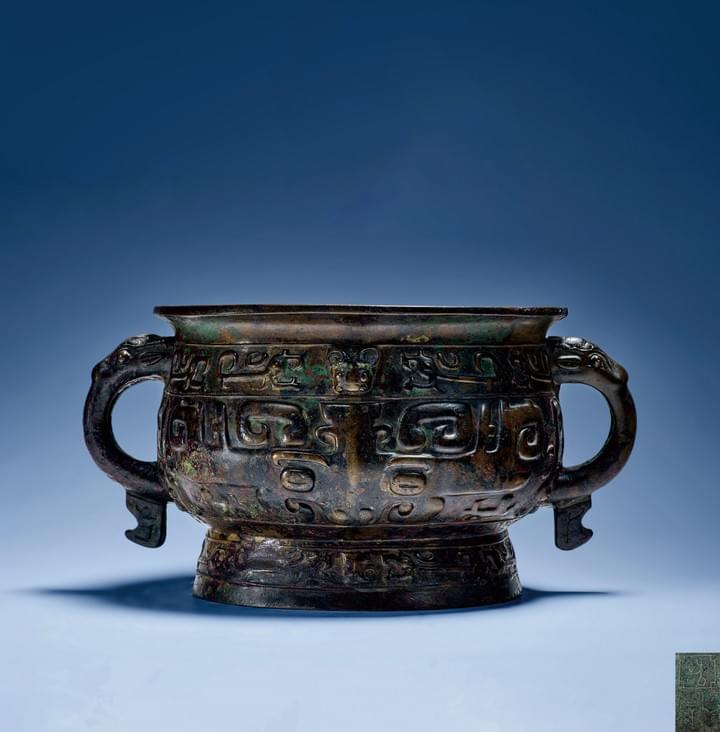
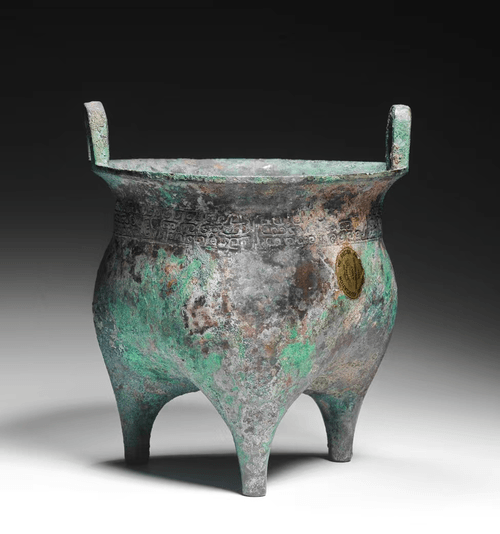
Dating to the late Shang–early Western Zhou period, this bronze li-shaped vessel features a flared mouth, tall constricted neck with taotie band and traces of black lacquer, thin rim with upright handles, and a pouch-shaped belly tapering into three columnar legs. The surface is adorned with leiwen motifs, and the interior bears the inscription “亯聿 (Xiang Yu)”. Standing 17 cm high, it exemplifies the transitional form between ding and li types and reflects refined craftsmanship. The vessel was formerly in the collection of Rong Hou (1874–1945), Manchu noble and first president of the Central Bank of Manchukuo, and was published in Umehara Sueji’s Kanka Rō Kichintō (1947), a seminal catalogue prefaced by Luo Zhenyu documenting 169 bronzes from Rong Hou’s renowned collection.
 This vessel dates to the transitional period between the late Shang and early Western Zhou. It has a flared mouth and constricted neck (shukou sujing), the neck encircled by a band of animal-mask motifs, originally filled with black lacquer. The rim is set with a pair of upright loop handles divided by vertical flanges.
The mouth opens outward with a thin lip. The two upright handles are sharply angled yet well-proportioned, lending the vessel a silhouette reminiscent of a ding. Around the neck runs a continuous band of oblique leiwen (thunder-pattern) motifs.
The bag-shaped body displays the characteristic form of a li tripod, gradually tapering downward into hollow columnar legs. The vessel represents an unusual and distinctive variation within the li typology and is of considerable importance both for its refined morphology and its well-documented provenance.
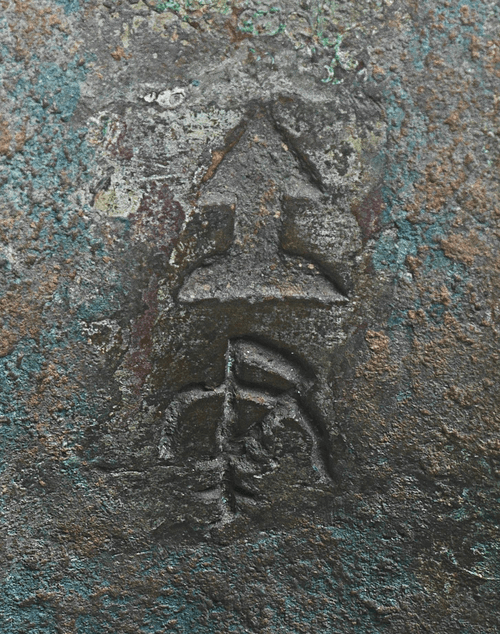
The interior bears a two-character inscription:
亯聿 (Xiang Yu)
Inscription
The graph 亯 is understood as an archaic form related to ritual offering and ancestral temple contexts, frequently associated with sacrificial activity. The character 聿, pictographically representing a writing brush, is an early graph that later evolved into forms associated with writing and official record-keeping.
The combination Xiang Yu likely records either the name of the vessel’s commissioner or a lineage designation. As is common with early Western Zhou transitional bronzes, the inscription is concise and emblematic rather than narrative.
Provenance
Rong Hou (1874–1945), Manchu of the Bordered Blue Banner, who successively served as Director of Finance of the Northeastern Provinces during the late Qing and Republican periods, and later as the first President of the Central Bank of Manchukuo.
Sir Michael Oppenheimer, 3rd Baronet (1924–2020), and Lady Helen Oppenheimer DD (1926–2022), formerly in their collection.
Publication
Umehara Sueji, Kanguolou Jijin Tu, Tokyo, 1947, vol. I, p. 40.
Zhongguo Shehui Kexueyuan Kaogu Yanjiusuo, Yin Zhou Jinwen Jicheng, Beijing: Zhonghua Shuju, 1984, no. 00454.
Zhongguo Shehui Kexueyuan Kaogu Yanjiusuo (ed.), Yin Zhou Jinwen Jicheng Shiwen, Hong Kong, 2001, vol. 1, p. 474, fig. 454.
Liu Yu, Shang Zhou Jinwen Zong Zhulu Biao, 2008, p. 85.
Wu Zhenfeng, Shang Zhou Jinwen Ziliao Tongjian, no. 0263.
Wu Zhenfeng, Shang Zhou Qingtongqi Mingwen Ji Tuxiang Jicheng, no. 0263.
著錄:
1. 梅原末治,《冠斝樓吉金圖》, 東京,1947年,第一冊,第40頁
2. 中國社會科學院考古研究所,《殷周金文集成》,中華書局,1984年,編號 00454
3. 中國社會科學院考古研究所編, 《殷周金文集成釋文》, 香港,2001年,卷1, 頁474,圖四五四
4. 劉雨,《商周金文總著錄表》,2008年,頁85。
5. 吳鎮烽 《商周金文資料通鑒》編號0263.
6. 吳鎮烽,《商周青銅器銘文暨圖像集成》,編號0263
Scholarly Note on the Guanjialou Collection
The present vessel was published in Umehara Sueji’s seminal 1947 Kankaro Kikkintō, a collotype-printed catalogue of 169 early bronzes, jue, mirrors, and related objects from the Guanjialou collection formed by Rong Hou. Rong Hou was an avid collector of Shang and Zhou bronzes and conducted personal epigraphic study of his holdings. The publication includes a preface by the eminent scholar Luo Zhenyu and was printed in high-quality collotype by the Kobayashi Photoengraving Company in Japan.
The Guanjialou bronzes have since dispersed onto the international market, and vessels with such early and traceable publication history are of particular importance within the study of archaic Chinese bronzes.