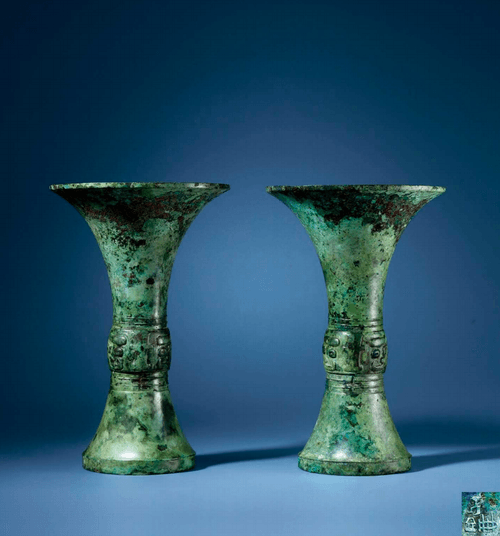
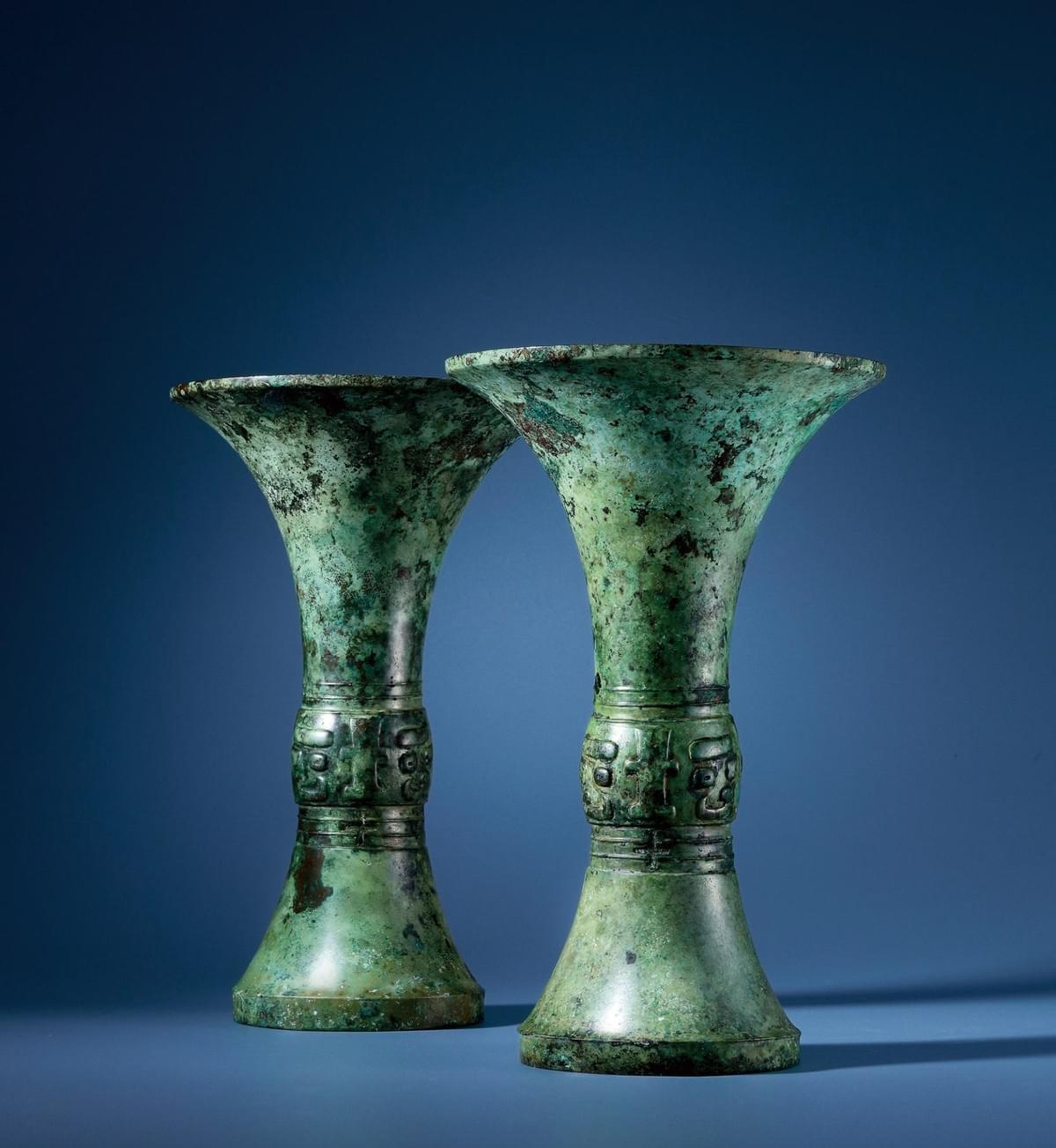
A RARE PAIR OF INSCRIBED BRONZE GU (商晚期 伒冊亯觚 一對)
Each elegantly cast with a flared trumpet mouth rising from a tall, waisted neck to a swelling central section, the lower body tapering to a high ring foot with the edge folded outward to form a pronounced flange, the central register crisply decorated with stylized bovine-horned taotie masks divided by flanges and bordered by raised bow-string bands, the interior of the foot cast with a clan emblem reading Jin Ce Xiang (伒冊亯), the surface with deep olive-green patina and areas of malachite encrustation.
Height: 22.2 cm Diamter: 13.9 cm
Accession nos. (Museum of Fine Arts, Boston): 313.40.a; 312.40.a
PROVENANCE
P. S. Hopkins (1887–1969), prior to 1931.
On loan to the Museum of Fine Arts, Boston, 1931 (accession nos. 313.40.a and 312.40.a).
Sold at Sotheby's, New York, 8 May 1981, lot 22 (hammer price: USD 15,000).
EXHIBITED
Museum of Fine Arts, Boston, 1931 (loan exhibition).
Exhibition and Literature
Museum of Fine Arts, Boston, loan exhibition, 1931 (accession nos. 313.40.a, 312.40.a).
Chen Mengjia, Chinese Bronzes in American Collections: A Catalogue and Comprehensive Study of Chinese Bronzes, 1947 manuscript, nos. A513, A514; R103, R104.
Shimono Yajiro, Shodō Zenshū, Tokyo: Heibonsha, 1954, pl. 18.
Chen Mengjia, Collected Record of Yin and Zhou Bronzes Looted by American Imperialism, Beijing, 1962, nos. A513, A514.
Chen Mengjia, Illustrated Typological Catalogue of Yin and Zhou Bronzes, Tokyo, 1977, nos. A513, A514 (plates); R103, R104 (inscriptions).
Noel Barnard and Zhang Guangyu, Compendium of Bronze Inscriptions as Seen in China, Japan, Europe, America, and Australasia, Taipei, 1978, nos. 1447, 1448.
Zhou Fagao, Supplement to the Corpus of Bronze Inscriptions of the Three Dynasties, Taipei, 1980, nos. 103, 104.
Sotheby's, May 8, 1981, Fine Chinese Ceramics, Works of Art and Paintings, lot 22.
Yan Yiping, Comprehensive Corpus of Bronze Inscriptions, Taipei, 1983, nos. 6177, 6178.
Hayashi Minao, Comprehensive Survey of Yin and Zhou Bronzes, vol. I (plates), Tokyo, 1984, Gu no. 172.
Institute of Archaeology, Chinese Academy of Social Sciences, Yin Zhou Jinwen Jicheng, Beijing: Zhonghua Shuju, 1984, nos. 07167, 07168.
Institute of Archaeology, CASS, Yin Zhou Jinwen Jicheng Shiwén, Hong Kong, 2001, vol. 4, p. 447, figs. 7167, 7168.
East China Normal University, Research Center for Chinese Characters, Index to Bronze Inscriptions: Shang and Western Zhou, 2001, vol. 1, p. 189.
Liu Yu, General Bibliography of Shang and Zhou Bronze Inscriptions, 2008, p. 986.
Wu Zhenfeng, Comprehensive Mirror of Shang and Zhou Bronze Inscription Materials, nos. 09658, 09659.
Wu Zhenfeng, Corpus of Shang and Zhou Bronze Inscriptions and Images, Shanghai, 2012, vol. 18, pp. 346–347, nos. 9658, 9659.
Jia Wenzhong and Jia Shu, Highlights of Auspicious Bronzes, Cultural Relics Press, 2016, p. 198, no. 231.
Cao Dazhi, “On Shang Dynasty Granary Facilities: Lin (㐭), Xiang (亯), and Jing (京),” Ancient Civilizations, vol. 13 (2019), p. 181.
著录
- 波士頓藝術博物館(Boston Museum of Fine Art), 1931年,借展,(Boston, 313.40.a, 312.40.a)
- 陳夢家, 《美國所藏中國銅器集錄》, Chinese Bronzes in American Collections: A Catalogue and A Comprehensive Study of Chinese Bronzes, 1947, manuscript, No. A513, 514, and R103,104
- 下中彌三郎,《書道全集》,東京平凡社,1954年,圖18,生活を表わした殷代金文
- 陳夢家,《美帝國主義掠奪的我國殷周青銅器集錄》,北京,1962年,编號A513 A514
- 陳夢家,《殷周青銅器分類圖錄》,東京,1977年,编號A513 A514(圖片)及R103 R104(銘文)
- 巴納(Noel Barnard),張光裕,台北,1978年,《中日歐美澳紐所見所拓所摹金文彙編》,編號1447,1448
- 周法高,《三代吉金文存補》,台北,1980年,編號103,104
- Sotheby’s, May 8, 1981, Fine Chinese Ceramics, Works of Art and Paintings,器22
- 嚴一萍,《金文總集》,台北,1983年,編號6177,6178
- 林巳奈夫,《殷周青銅器綜覽》,卷一(圖版),東京,1984年,觚172
- 中國社會科學院考古研究所, 《殷周金文集成》,中華書局,1984年,編號07167,07168
- 中國社會科學院考古研究所編, 《殷周金文集成釋文》, 香港,2001年,卷4, 頁447,圖七一六七、七一六八
- 華東師範大學中國文字研究與應用中心,《金文引得·殷商西周卷》,2001年,卷1,頁189.
- 劉雨,《商周金文總著錄表》,2008年,頁986
- 吳鎮烽 《商周金文資料通鑒》編號09658,09659.
- 吳鎮烽,《商周青銅器銘文暨圖像集成》,上海,2012,卷18,页346,347,編號9658,9659
- 賈文忠,賈樹,《吉金萃影》,文物出版社,2016年,頁198,編號231
- 曹大志,《論商代的粮储設施,㐭、亯、京》,《古代文明》第13卷,2019年,頁181
SCHOLARLY COMMENTARY
The present pair represents one of the rarest and most architecturally assertive types among late Shang bronze gu. Though modest in absolute scale, the vessels convey unusual monumentality through their thickened body walls, elongated neck, and sharply defined, high-flanged ring foot. This structural emphasis distinguishes them from the more slender, attenuated gu forms typical of earlier Anyang production.
The decorative register is dominated by bovine-horned taotie masks rendered in high relief and framed by bow-string bands. The restrained yet powerful ornamentation, combined with the robust proportions, aligns closely with bronzes attributed to Yinxu Phase III, corresponding to the late 12th–early 11th century BC. The Japanese scholar Hayashi Minao classified related examples within this phase, noting their distinctive volumetric treatment and emphasis on sculptural mass.
The inscription inside the foot, transcribed by Chen Mengjia as “Jin Ce Xiang” (伒冊亯), is understood as a clan emblem rather than a dedicatory text. The graph ce (冊), pictographically representing bound bamboo slips and defined in the Shuowen Jiezi as a royal mandate, frequently appears in Shang clan emblems. Its presence may indicate association with the office of zuoce (royal scribe). Cao Dazhi’s statistical study records 279 Shang bronzes bearing the graph ce within clan insignia, underscoring its administrative and possibly hereditary significance within Shang political structure.
Pairs of gu bearing identical clan emblems are of particular importance, suggesting production for ritual use within a single lineage context. Comparable examples include the “Yagu Fu Ji Gu” sold at Poly Auction, Spring 2014, lot 3565, and a related example illustrated in Fan Jirong’s Shouyang Jijin (no. 22).
The distinguished early 20th-century provenance, including documented loan to the Museum of Fine Arts, Boston in 1931, further enhances the historical significance of this rare and extensively published pair.