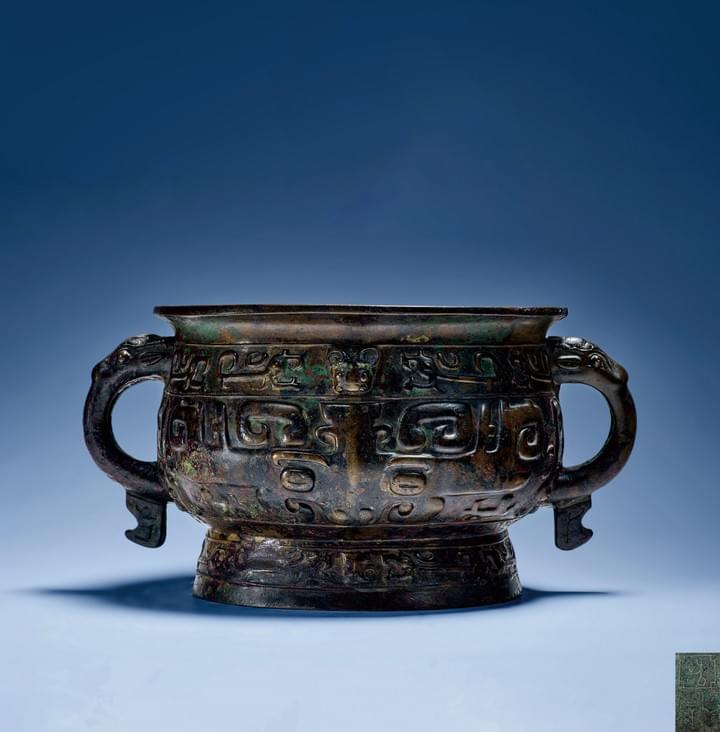
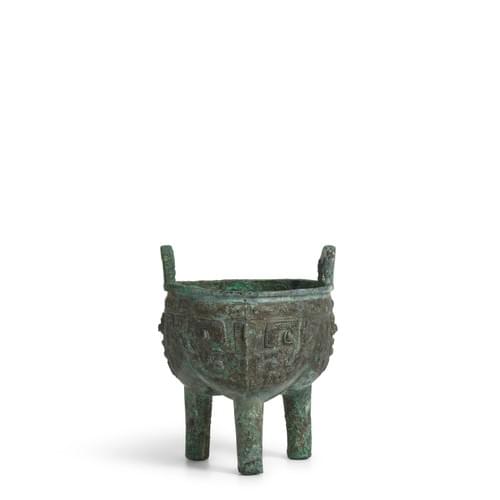
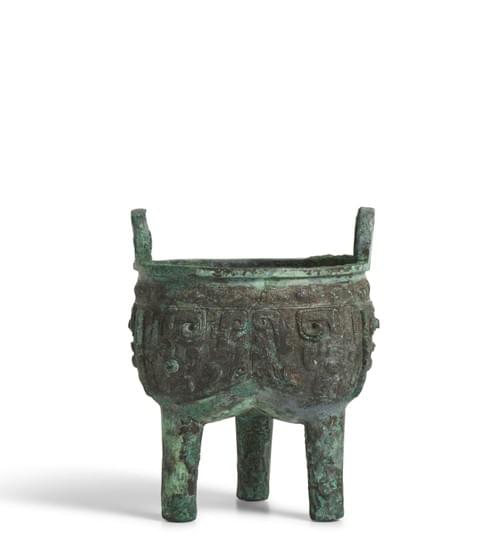
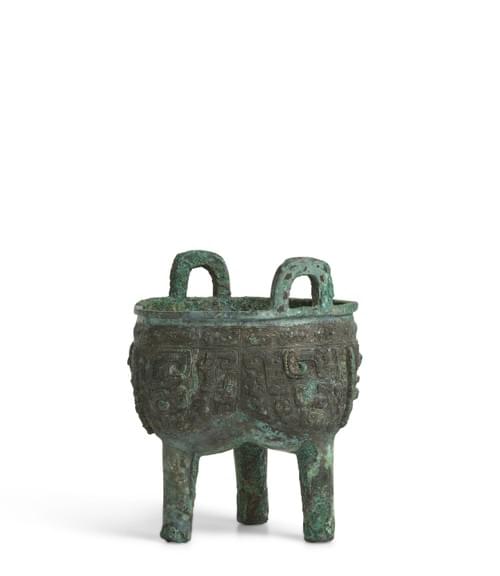
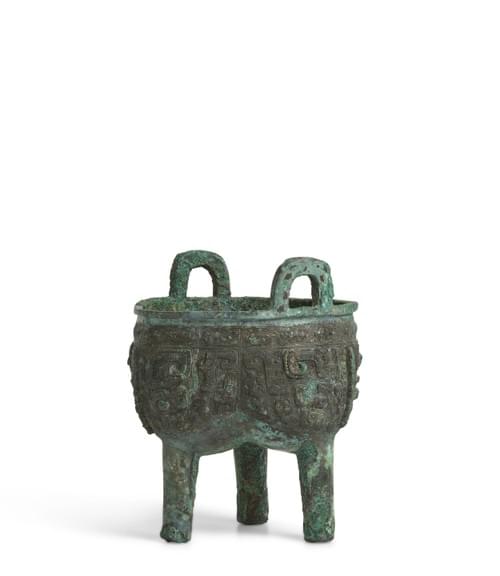
AN ARCHAIC BRONZE RITUAL FOOD VESSEL (LIDING) LATE SHANG DYNASTY
Late Shang Dynasty (circa 12th–11th century BC)
Height: 20.3 cm
The li-ding, commonly referred to as a “separated-crotch ding,” represents a hybrid form combining elements of the ding and the li. The upper portion resembles a ding, while the lower body adopts the pouched form characteristic of a li. Unlike the typical hollow bag-legs of the li, however, it stands on relatively elongated conical or columnar legs, distinguishing it structurally from the standard li type.
The li-ding first appeared in the early Shang dynasty and developed fully by the late Shang period. By the early Western Zhou, its defining separated-crotch feature became increasingly indistinct, and the form gradually degenerated, blurring the distinction between li-ding and ordinary ding vessels.
This example, dating to the late Shang dynasty, displays a well-matured patina indicative of long transmission. It has a flat, square-rimmed mouth and a pair of upright loop handles. The slightly constricted neck rises above three pronounced pouched lobes, each terminating in a columnar leg.
The vessel is decorated using the so-called “three-layered pattern” technique. The neck is divided by six raised flanges; within each segment appear three horizontal cicada motifs arranged symmetrically along the axis of the flange and set against a leiwen (thunder-pattern) ground.
Shang dynasty cicada motifs are wingless and appear in two types—nymph and adult. Their rectangular configuration allows both horizontal and vertical placement. In bronzes of the late Shang and early Zhou periods, cicadas are generally subsidiary motifs. On ding vessels they are often arranged vertically on the abdomen, sometimes framed by inverted triangular elements, forming the so-called “triangular cicada pattern.” On vessels such as gu, hu, and you, cicada motifs are typically arranged horizontally; adult forms may be rendered with two or four legs.
Each of the three pouched lobes is further defined by three raised flanges that serve as the central axis for ram-horn-type taotie masks. The horns curve upward at the base and coil inward and downward, recalling in planar conception the horn formation seen on the celebrated Four-Ram Square Zun. This horn configuration is exceedingly rare among extant bronzes. The paired horns are robust and powerfully modeled, covered with dense linear striations; the descending claws are sharply articulated. The overall effect is both fierce and magnificent, creating strong visual impact and considerable artistic significance.
The vessel is accompanied by its original storage box, inscribed as formerly in the collection of Ozawa Yoshio (Ōsawa Yoshio), a Meiji-period collector based in Kyoto. Works from his collection were exhibited at the Kyoto Imperial Museum, as recorded in Kyoto Bijutsu Kyōkai Zasshi, no. 150, miscellaneous reports, p. 29, and in Jidai Chinretsu Mokuroku (From Enryaku 1 to the End of Keio), Special Supplement, Vol. II, Fourth Period, Painting section, p. 21.
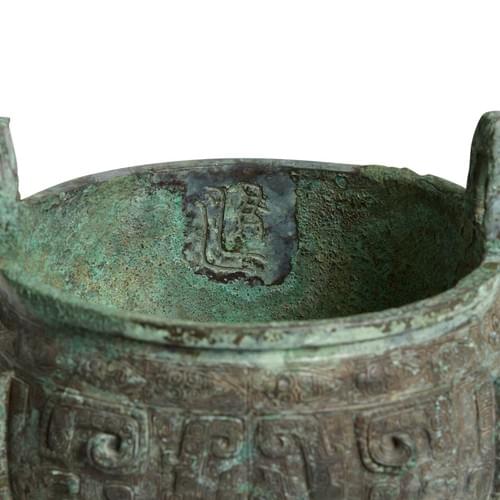
The vessel bears a single-character inscription. In comparison with the graph Yong (雝), the present character omits the lü component. An identically inscribed tripod of the same size and decoration is preserved in the Ashmolean Museum, University of Oxford, and may originally have formed a pair with the present vessel. The Ashmolean example was donated in 1956 by Sir Herbert Ingram.
Provenance:
Ōsawa Yoshio, Meiji period
Christie's London, 5 June 1973, lot 251, acquired by the House of Cheng Looi
Sotheby's London, 1-2 April 1974, lot 69, acquired by Mrs. Geraerts
Sotheby's London, 25 March 1975, lot 151
Hirano Kotoken, Tokyo
Sotheby's New York, 23 March 2017, lot 598
Exhibited:
Kyoto National Museum, 1970s until 2016 (on loan)
An inscribed companion tripod bearing the same character is preserved in the Ashmolean Museum, University of Oxford, United Kingdom, and may be consulted for reference.