Former Collection of Dr. Wu Quan Mahāprajñāpāramitā Sūtra (Dabanruo boluomiduo jing), Scroll 130
Yao Liang
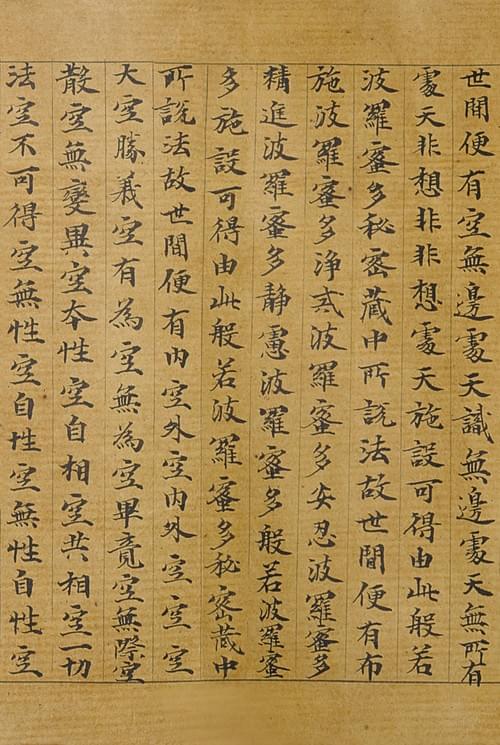
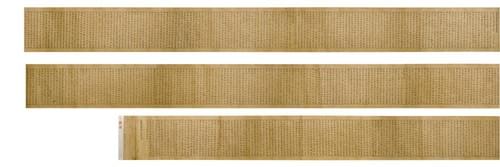
The Mahaprajnaparamita Sutra (The Large Perfection of Wisdom Sutra) (section), ink on paper, handscroll
姚良 大般若波羅蜜多經(部分) 水墨紙本 手卷
ink on paper, handscroll
經文釋文略
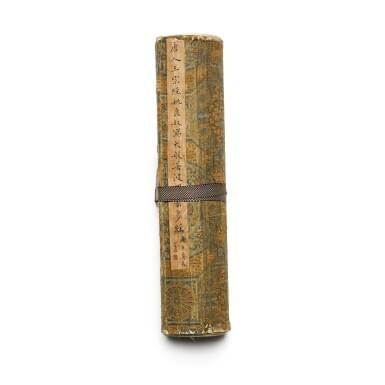
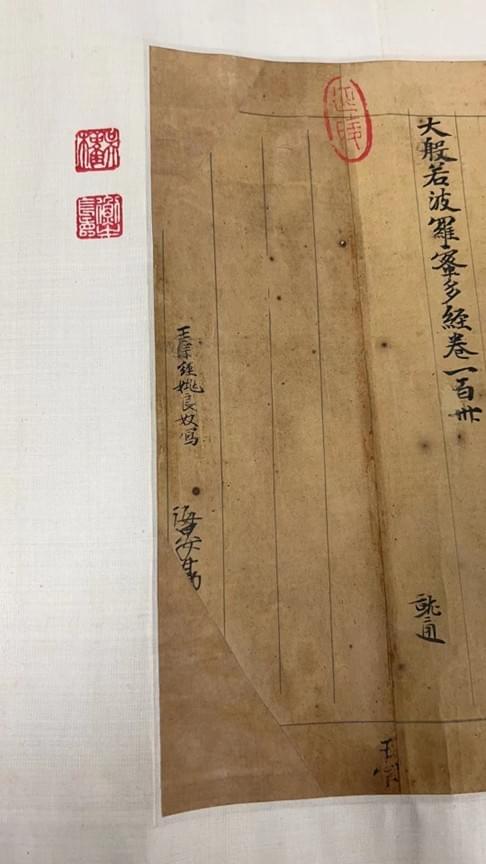
外簽:唐人王宗經姚良奴寫大般若波羅蜜多經。庚午莫春。□□。鈐印:鑒□
款識:王宗經姚良奴寫。鈐印:延陵。鑒藏印:吳權、衡之長壽
Height 9¾ in., 24.8 cm; Width 299¾ in., 761.5 cm
Condition report
Provenance
Collection of Dr Wou Kiuan (1910-1997).
Wou Lien-Pai Museum, coll. no. 275.
吳權博士 (1910-1997) 收藏
吳蓮伯博物院,編號275
Sold
Summary Description
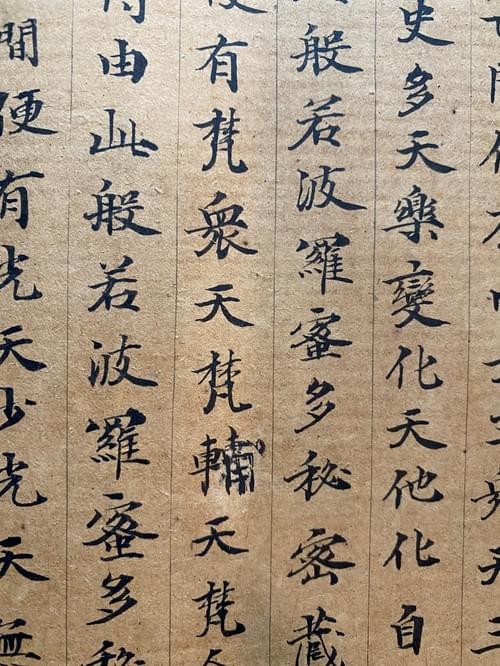
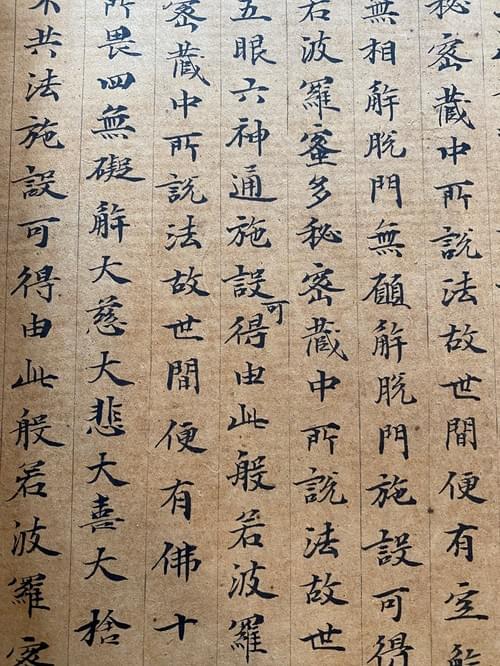
This manuscript comprises Scroll 130 of the Mahāprajñāpāramitā Sūtra. The scroll measures 25 cm in height and 744 cm in total length, consisting of sixteen sheets joined together. Each sheet measures 25 cm in height, with ruled black-ink column lines (wusi lan) measuring 20.5 cm in height.
The first sheet contains 26 lines of text; sheets two through sixteen each contain 28 lines. The sheet lengths are as follows:
Sheet 1: 40.8 cm
Sheet 2: 47.3 cm
Sheet 3: 47.2 cm
Sheet 4: 47.3 cm
Sheet 5: 47.3 cm
Sheet 6: 47.2 cm
Sheet 7: 47.2 cm
Sheet 8: 47.3 cm
Sheet 9: 47.3 cm
Sheet 10: 47.2 cm
Sheet 11: 47.3 cm
Sheet 12: 47.2 cm
Sheet 13: 47.2 cm
Sheet 14: 47.3 cm
Sheet 15: 47.2 cm
Sheet 16: 47.5 cm
The swallow-tail terminal section (yànwěi) measures 25 × 6.8 cm.
Physical Condition and Mounting
The manuscript survives complete at both beginning and end. The black ruling lines remain intact, and the paper exhibits clear screen-pattern impressions (liánwén). The swallow-tail section retains its original scroll core and preserves several scribal colophons and four proofreading annotations.
Among extant Tang dynasty manuscripts, examples that are complete at both ends and preserve multiple scribal and proofreading colophons are exceedingly rare — fewer than one in a hundred survive in such condition.
The scroll was remounted in 1930, with a Song-brocade frontispiece, crystal scroll knobs, and white jade scroll-end fittings.
The exterior label was inscribed during the Republican period by the well-known calligrapher Lin Zunyan, reading:
“Tang manuscript of the Mahāprajñāpāramitā Sūtra, written by Wang Zongjing and Yao Liangnu. Late Spring of the gengwu year. Zunyan.”
Seal: Youmei.
Seals at the end of the scroll read: Yanling; Wu Quan; Hengzhi Changshou.
Scribal and Proofreading Colophons
At the end of the scroll appears the scribal signature “Jiutong.” Research confirms that the British Museum (now the British Library) preserves Tang manuscript S.933, Scroll 276 of the Mahāprajñāpāramitā Sūtra, which bears the colophon “Jiutong” and “Jiutong, one sheet corrected by Zi Dui,” including proofreading annotations.
On the swallow-tail section, outside the black ruling lines, appears another scribal signature: “Wang Zong.”
British Museum manuscripts S.492, S.3281, and S.5243 (Mahāyāna Amitāyus Sūtra) also preserve the scribal signature of Wang Zong.
The final column of the swallow-tail bears:
Scribal colophon: “Written by Wang Zongjing and Yao Liangnu.”
Proofreading colophon: “Proofread by Haiyan.”
British Museum manuscript S.2690 (Mahāprajñāpāramitā Sūtra, Scroll 413) likewise contains a proofreading colophon by Haiyan. Manuscript S.6417 2(a) (“Model Text”) refers to “Haiyan, Grand Sangha Commissioner of Puguang Monastery.” Manuscript S.2575 (“Monastic Registry”) includes references to the “Hexi Grand Sangha Commissioner, Haiyan.”
The epitaph Hexi Du Sengtong Yin Haiyan Muzhiming bing xu (P.3720) confirms that Yin Haiyan served as Grand Sangha Commissioner of Hexi in the late Tang period. It may therefore be concluded that this manuscript was proofread by Yin Haiyan during the late Tang, and thus cannot postdate the year 900 CE (Guanghua 3, reign of Emperor Zhaozong of Tang).
Identification of the Scribes
The final swallow-tail column bears the scribal colophon:
“Written by Wang Zongjing and Yao Liangnu.”
Although no direct record of Yao Liangnu or Wang Zongjing appears in extant Tang manuscript catalogues, earlier evidence confirms the scribal signature of Wang Zong in related Dunhuang manuscripts.
Furthermore, in Tang naming conventions, the suffix “nu” often functioned as a nominal element within personal names. British Museum manuscripts S.4502 (Mahāprajñāpāramitā Sūtra, Scroll 416), S.1837 (Amitāyus Sūtra), S.1993 (Mahāyāna Amitāyus Sūtra), and S.702 (Amitāyus Sūtra) contain the scribal signature “Yao Liang.”
Comparison of the handwriting in those manuscripts with the present scroll reveals close palaeographic correspondence, strongly suggesting that “Yao Liangnu” and “Yao Liang” refer to the same individual.