
Go Back
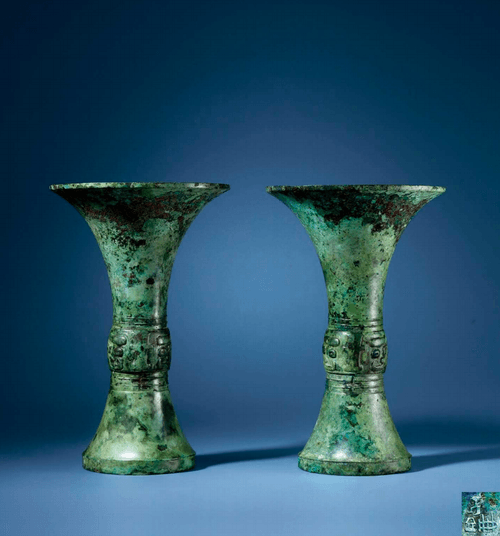
Gu Pair (商晚期 伒冊亯觚 一對)
Late Shang Dynasty, 13th century BC
Inscription: 伒冊亯
Heights: 22.2cm (No. 1), 21.9cm (No. 2)
Provenance:
Collection of P.S. Hopkins, prior to 1931
Museum of Fine Arts, Boston, accession nos. 312.40.a, 313.40.a Sotheby’s, New York, May 8, 1981, Lot 22
The form, size, and ornamentation of this gu represent one of the rarest types among late Shang bronze gu vessels. Lin Si-nai classified this type within Phase III of the Yinxu period. Comparable examples include the Ya Gu Fu Ji gu, Lot 3565, sold in the Chinese Works of Art sale at Poly Auction, Spring 2014, and the gu illustrated as no. 22 in Fan Jirong’s Shouyang Jijin.
The pair of gu was lent to the Museum of Fine Arts, Boston in 1931; museum accession numbers (inscribed inside the foot) are 313.40.a and 312.40.a. According to the transcription recorded by Chen Mengjia, the inscription is read as “Qin ce xin” and is believed to represent a clan emblem.
Inscription: 伒冊亯
Heights: 22.2cm (No. 1), 21.9cm (No. 2)
Provenance:
Collection of P.S. Hopkins, prior to 1931
Museum of Fine Arts, Boston, accession nos. 312.40.a, 313.40.a Sotheby’s, New York, May 8, 1981, Lot 22
The form, size, and ornamentation of this gu represent one of the rarest types among late Shang bronze gu vessels. Lin Si-nai classified this type within Phase III of the Yinxu period. Comparable examples include the Ya Gu Fu Ji gu, Lot 3565, sold in the Chinese Works of Art sale at Poly Auction, Spring 2014, and the gu illustrated as no. 22 in Fan Jirong’s Shouyang Jijin.
The pair of gu was lent to the Museum of Fine Arts, Boston in 1931; museum accession numbers (inscribed inside the foot) are 313.40.a and 312.40.a. According to the transcription recorded by Chen Mengjia, the inscription is read as “Qin ce xin” and is believed to represent a clan emblem.


