
Go Back
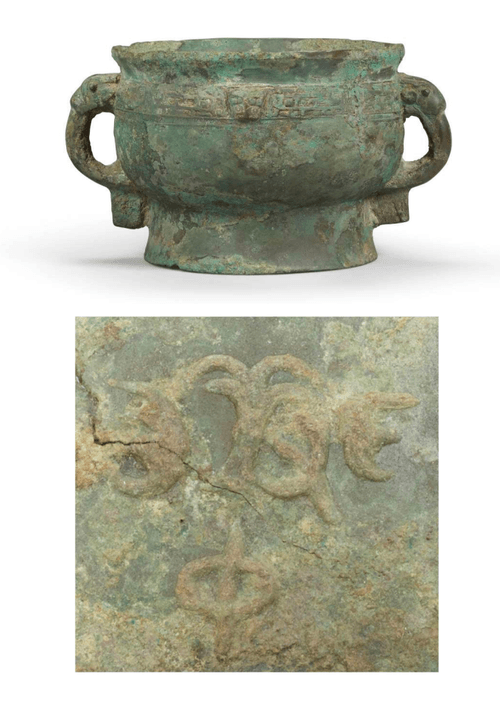
Gui (聑秉毌簋)
Early Western Zhou Dynasty, 9th century BC
Mouth diameter: 21cm Provenance:
Kusaka Shogyado, Tokyo, Japan, December 22, 1958.
Collection of Mark S. Pratt, Washington, D.C.
Of circular form with an everted rim, swelling body, ring foot, and a pair of beast-head handles. The neck is cast with animal heads in symmetrical arrangement at the front and back, flanked on either side by bands of kui-dragon scroll. A raised bow-string band encircles the belly. Inscription: Er Bing Wu.
The rubbing of the Er Bing Wu inscription included in the Compendium of Bronze Inscriptions Seen, Rubbings, and Copies in China, Japan, Europe, America, and Australasia derives from this very piece. The Bing Zhong ding has long since vanished; only through the survival of the present vessel has the inscription been preserved.
Mouth diameter: 21cm Provenance:
Kusaka Shogyado, Tokyo, Japan, December 22, 1958.
Collection of Mark S. Pratt, Washington, D.C.
Of circular form with an everted rim, swelling body, ring foot, and a pair of beast-head handles. The neck is cast with animal heads in symmetrical arrangement at the front and back, flanked on either side by bands of kui-dragon scroll. A raised bow-string band encircles the belly. Inscription: Er Bing Wu.
The rubbing of the Er Bing Wu inscription included in the Compendium of Bronze Inscriptions Seen, Rubbings, and Copies in China, Japan, Europe, America, and Australasia derives from this very piece. The Bing Zhong ding has long since vanished; only through the survival of the present vessel has the inscription been preserved.


