

Go Back
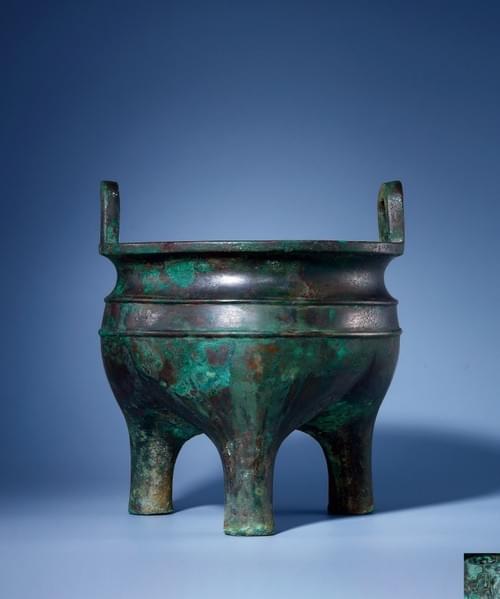
Li Ding (舉父己鬲鼎)
Late Shang to Early Western Zhou Dynasty, 12th-11th century BC
Inscription: 舉父己
Height: 22.7cm
Provenance:
Collection of Alan and Simone Hartman, Hartman Rare Art, 1980s
Private Collection, New York, 1990s
This bronze vessel, transitional between a ding and a li, dates to the late Shang–early Western Zhou period. It features a flared mouth with upright loop handles, a tall neck with double string bands, a pouch-shaped belly, and three columnar legs. The undecorated surface reflects the early Western Zhou aesthetic that valued simplicity when bronze resources were limited. Such hybrid forms illustrate the evolution of ritual bronzes from Shang to Zhou styles. An inscription inside the rim reads “舉父己 (ju fu ji)”, interpreted by Ma Xulun as ju (舉). Cao Dazhi later argued x may represent an early form of ji (季), denoting the youngest branch within a lineage. Comparative studies by Song Huaqian and Li Xueqin support this reading, suggesting the inscription refers to a collateral or junior family member who commissioned or dedicated the vessel.
Inscription: 舉父己
Height: 22.7cm
Provenance:
Collection of Alan and Simone Hartman, Hartman Rare Art, 1980s
Private Collection, New York, 1990s
This bronze vessel, transitional between a ding and a li, dates to the late Shang–early Western Zhou period. It features a flared mouth with upright loop handles, a tall neck with double string bands, a pouch-shaped belly, and three columnar legs. The undecorated surface reflects the early Western Zhou aesthetic that valued simplicity when bronze resources were limited. Such hybrid forms illustrate the evolution of ritual bronzes from Shang to Zhou styles. An inscription inside the rim reads “舉父己 (ju fu ji)”, interpreted by Ma Xulun as ju (舉). Cao Dazhi later argued x may represent an early form of ji (季), denoting the youngest branch within a lineage. Comparative studies by Song Huaqian and Li Xueqin support this reading, suggesting the inscription refers to a collateral or junior family member who commissioned or dedicated the vessel.


