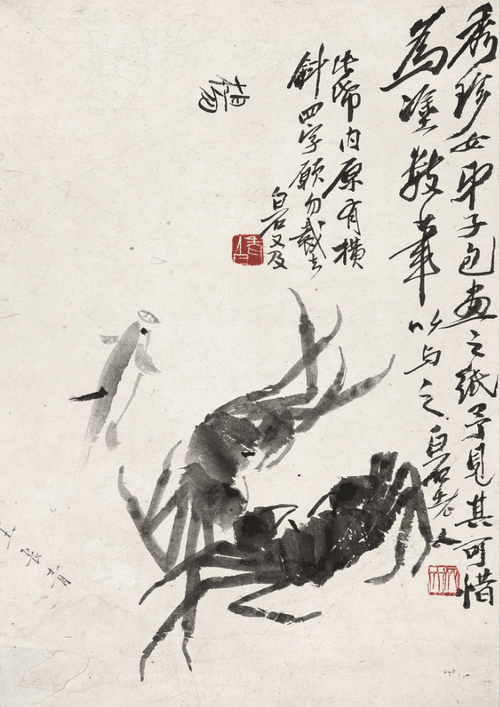
Qi Baishi (1864–1957) Hanging Scroll, ink (and color) on paper
Inscriptions
“Xiuzhen, my young female disciple, used this sheet to wrap a painting. Seeing it, I found it too fine to waste, and so applied a few strokes for her.”
— Baishi Laoren
Seal: Qi Da
“There were originally four slanting characters on this paper; I hope they will not be cut away.”
— Baishi again
Seal: Lao Bai
Note
The recipient, Yang Xiuzhen (1909–2008), originally named Niu Lingxian, was a native of Qingzhou, Shandong. After the May Fourth Movement, she became one of the few female painters to achieve prominence in the modern Chinese art world. She excelled in bold freehand flower painting and fine-line depictions of insects. Her brushwork combined delicacy and vigor, strength and suppleness, and she was widely regarded as the foremost among Qi Baishi’s female disciples.
According to members of Qi Baishi’s family, Yang Xiuzhen would almost invariably be the first each morning to pay her respects to the Master. The present work was originally intended merely as wrapping paper. Noticing four diagonally written characters already on the sheet, Qi Baishi humorously painted a small fish aligned with their slant. He later reoriented the composition and added a pair of crabs in upright format.
This spontaneous transformation demonstrates not only the artist’s frugality and reverence for materials, but also his exceptional compositional intelligence. What began as discarded paper became a lively and witty pictorial improvisation, revealing Qi Baishi’s playful spirit and mastery of spatial invention.
Stylistic Analysis and Dating
The brushwork, inscriptional manner, and seal usage suggest a work of Qi Baishi’s later mature period (likely 1930s–1940s). During this phase, the artist’s style reached full expressive confidence:
Fish are rendered with abbreviated yet forceful ink strokes, emphasizing movement over anatomical detail.
The crabs are constructed through angular, calligraphic lines with controlled washes defining mass.
The composition balances diagonal dynamism (derived from the pre-existing characters) with vertical stabilization — a sophisticated response to accidental visual structure.
Such playful adaptations of incidental surfaces are consistent with Qi Baishi’s late-life philosophy of spontaneity (ziran) and creative transformation.
Auction Record
Sold at China Guardian Auctions, Beijing,
Fine Chinese Modern and Contemporary Paintings and Calligraphy,
China Guardian Autumn Auctions 2022,
13 December 2022, 9:30 a.m., lot 0414.