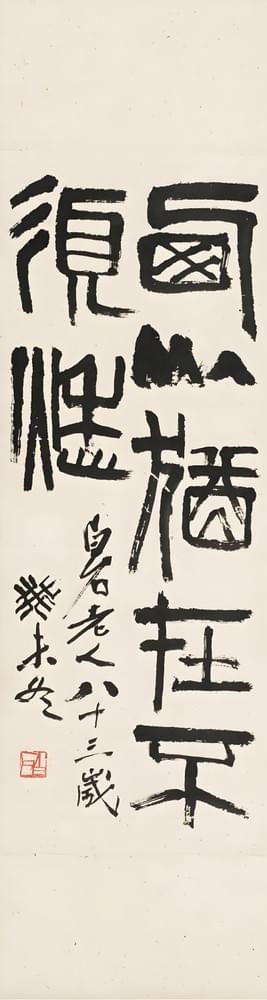
Qi Baishi (1864–1957) “West Mountain Still Stands — There Is No Need for Sorrow” Seal Script
Inscription
Signed:
“Baishi Laoren, aged eighty-three, winter of Guiwei year.”
Seal:
Baishi (in red)
Title Slip
Inscribed on the mounting: “Calligraphy by Qi Baishi.”
Collector’s seal:
Seal of Huangyun Lou of Yuanshan.

Publication
Zhongguo Shenghuo (China Life Pictorial), p. 21, Issue no. 8, 1947.
Transcription
“West Mountain still stands — there is no need for sorrow.”
Note
After the conclusion of this sale, collection of the lot will take place in Hong Kong, China.
The line “West Mountain still stands — there is no need for sorrow” is drawn from Qi Baishi’s lyric poem Xijiangyue: Revisiting Taoran Pavilion and Gazing at the Western Hills. In the early 1940s, when Qi Baishi was already of advanced age, he intended to purchase a burial plot near Taoran Pavilion as his eventual resting place. Upon learning of this, the monks of Cibei Temple generously presented him with two mu of land. In gratitude, Qi carved the seals “Jieshan Ji” (“Record of Borrowed Hills”) and inscribed the plaque “Taoran Pavilion.”
During the Japanese occupation of Beijing, Qi Baishi ascended Taoran Pavilion together with Zhang Cixi and composed the lyric Xijiangyue: Revisiting Taoran Pavilion and Gazing at the Western Hills, which reads in part:
“After forty years I return once more;
Three thousand li away, I wander again.
Though my hair has thinned, it cannot yet whiten my whole head;
Red oars and emerald balustrades remain as before.
The city walls are not devoid of cranes’ calls;
Reeds and rushes stretch endlessly in drifting mist.
West Mountain still stands — there is no need for sorrow;
Why let tears dampen sleeves?”
The poem expresses Qi Baishi’s patriotic sentiment during wartime and conveys his steadfast conviction that resistance against Japanese aggression would ultimately prevail.
Additional Note
The title slip was inscribed by Huang Beishou, a relative of Huang Junbi. Having long resided in the United States, Huang Beishou co-founded the Huang Clan Association in America together with Huang Renjun and Huang Jinbo, and was one of its senior founding members.
Provenance Note
This scroll was previously handled by Bo Gu Gallery and was sold in a private transaction as a work attributed to Qi Baishi, due to uncertainties regarding its authenticity at the time.
Subsequently, the purchaser identified a period publication in Zhongguo Shenghuo (1947, Issue 8, p. 21), in which this scroll was reproduced. On the basis of that publication and further scholarly confirmation, the work was recognized as authentic.
The scroll was later offered at auction.
Bo Gu Gallery acknowledges that the earlier attribution reflected the limitations of available documentation at the time of sale.