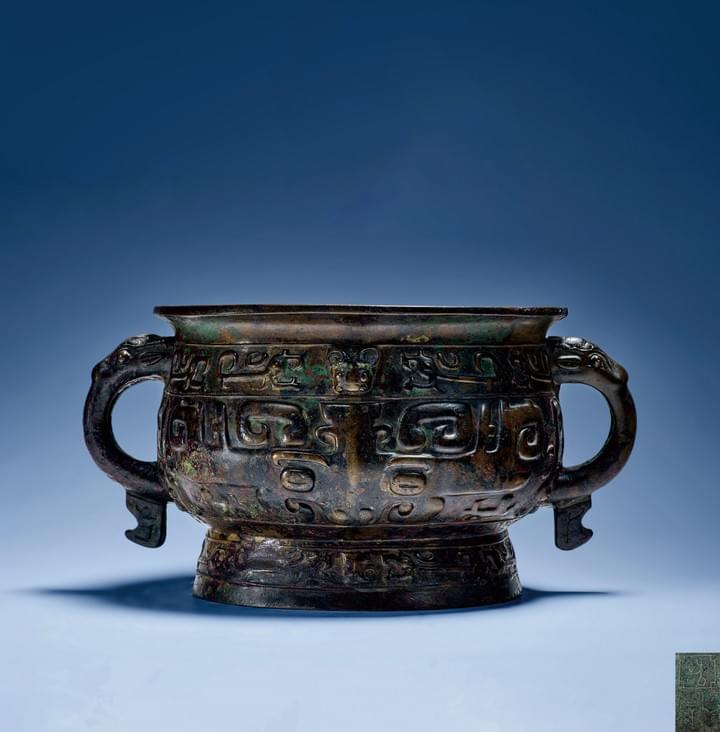
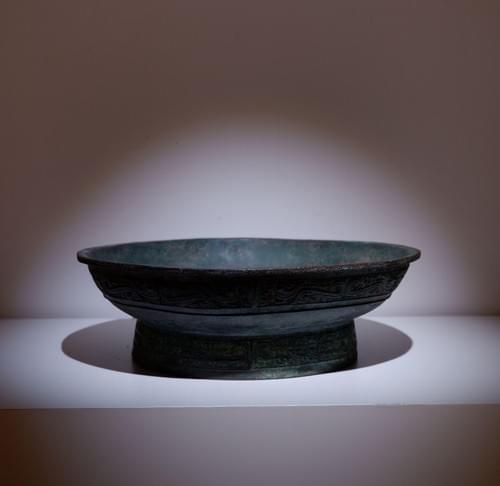
Ruigong ShuZ Bronze Pan 芮公叔盤
Late Middle Western Zhou period, corresponding approximately to the reigns of King Zhao and King Mu (Zhao–Mu period).
Dimensions
Height: 9.9 cm
Mouth diameter: 35.4 cm
Form and Decoration
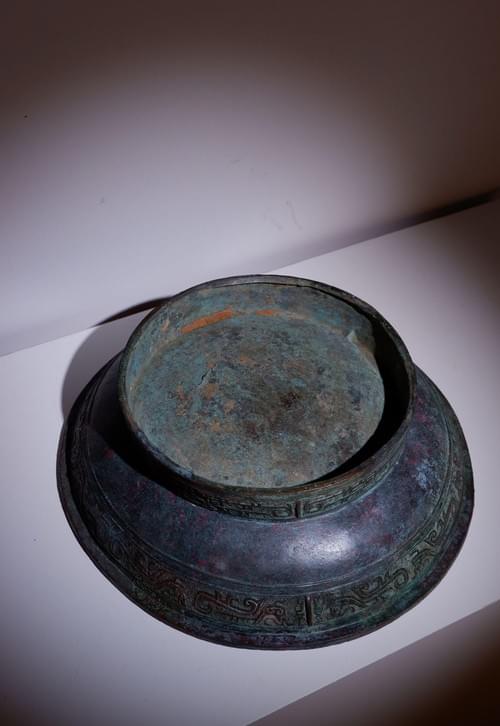
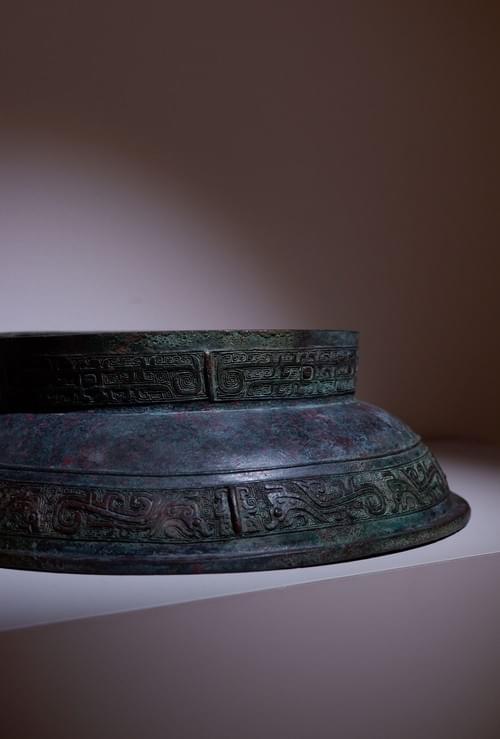
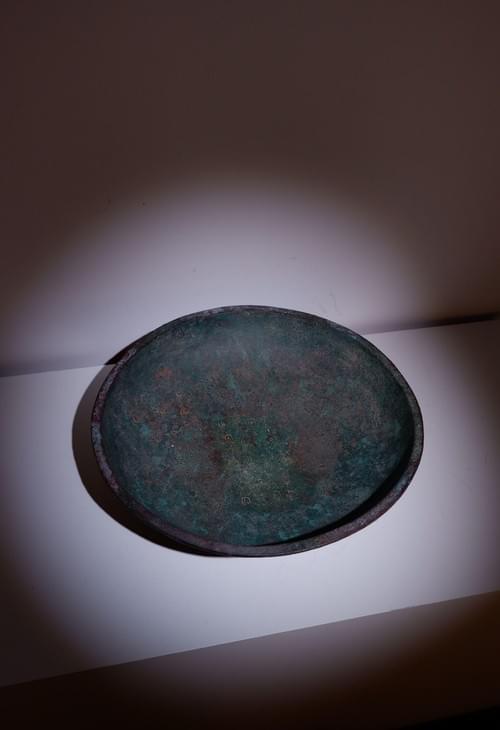
The vessel has a straight mouth and shallow basin, with a narrow rim and squared lip. It lacks handles. The ring foot is relatively tall and does not flare outward.
The body is decorated with elongated bird motifs (chang wu wen 長烏紋), while the ring foot bears kui-dragon motifs (kui long wen 夔龍紋), both set against a ground of leiwen (cloud-and-thunder) pattern.
The long-tailed bird motif belongs to Type III-4 of the bird-pattern typology. Both the stylistic features and ornamental vocabulary retain an early Western Zhou character. Accordingly, this pan should date to the Zhao–Mu period, and certainly no later than the reign of King Mu.
Inscription
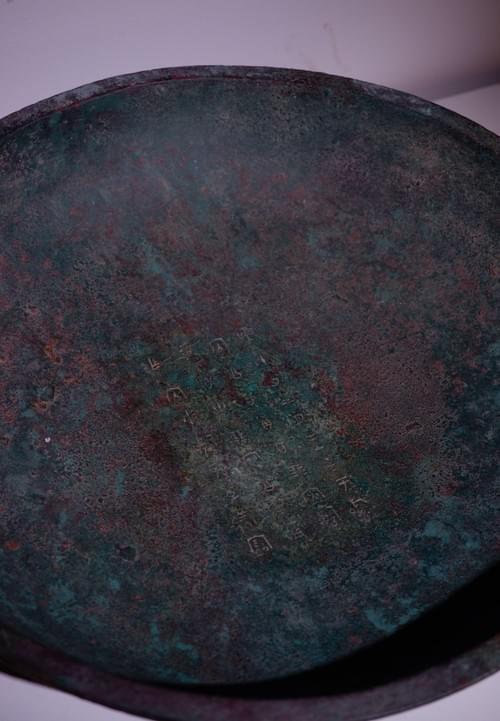
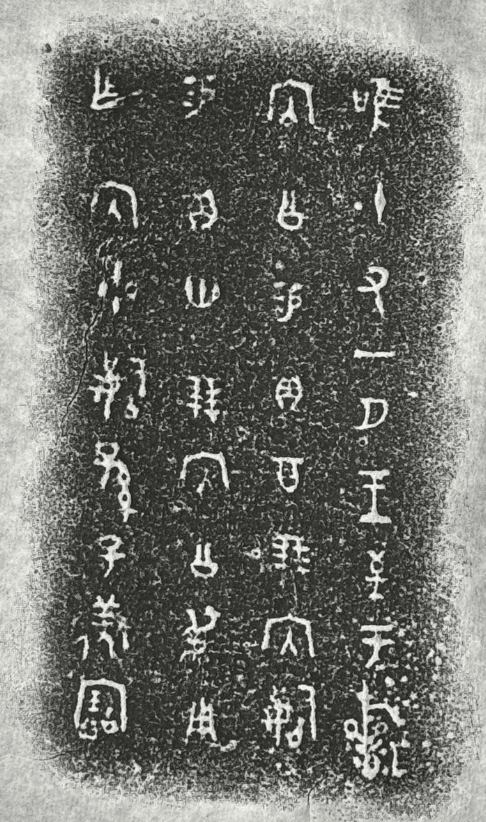
Cast inside the basin is an inscription of 33 characters.
Transcription (in modern characters)
唯十又一月,王至于祈,內(芮)公易(錫)貝百朋,內(芮)(姒)易(錫)貝卅朋。內(芮)公弔(叔)用乍(作)內(芮)少(姒),孫子(永)寶。
Translation
“In the eleventh month, the King arrived at Qi. He bestowed one hundred peng of cowries upon the Lord of Rui, and thirty peng upon Lady Rui Si. Lord Rui Shu made this vessel for Lady Rui Shao Si, for sons and grandsons to treasure forever.”
Historical and Epigraphic Commentary
(1) “The King arrived at Qi” (王至于祈)
The phrase Wang zhi yu Qi indicates that the Zhou king visited Qi. Since the king there bestowed gifts upon members of the Rui ruling house, Qi must have been located within the territory of Rui.
“Qi” is likely an abbreviation (or an omission in casting) for Qi Gong (祈宮), the ancestral temple of Duke Qi, father of Lord Rui and Lord Rui Shu.
Bestowals conducted within the ancestral temples of feudal lords are well attested in Western Zhou bronze inscriptions. Examples include:
Ling ding 令鼎
X pan 㺇盤
Da Shi Zuo gui 大師虘簋
Yin Ji li 尹姞鬲
In these cases, the Zhou king (or queen) conferred gifts within the ancestral temples of ministers or regional rulers.
(2) “Rui Gong bestowed cowries” (芮公賜貝)
The phrase appears syntactically inverted, a common feature of archaic Chinese. It should be understood as:
“The King bestowed cowries upon Rui Gong.”
He awarded 100 peng of cowries to Rui Gong and 30 peng to Rui Si, his consort.
Comparable inverted constructions occur in:
Zhong Yi yan 仲邑甗
Shu he 束盉
In all such cases, the true subject is the king mentioned previously.
(3) Identity of Rui Gong and Rui Gong Shu
A central scholarly debate concerns whether:
Rui Gong and Rui Gong Shu were two brothers, or
They were the same individual, with “Shu” being a personal name or generational designation.
Wu Zhenfeng (Wu Zhenfeng)
Argues they were brothers.
Rui Gong: ruler of Rui
Rui Gong Shu: younger brother
Rui Si and Rui Shao Si: sisters-in-law
Huang Jinqian (Huang Jinqian)
Argues they were the same person.
“Rui Gong” = title
“Shu” = personal name
Rui Si and Rui Shao Si likewise identical
However, as has been observed, generational designations such as gong shu or gong zhong typically refer to sons of a “gong.” It would be unusual for a ruling lord himself to bear such a subordinate generational marker.
The matter remains debated.
(4) Why Did Rui Gong Shu Cast the Vessel?
If the king bestowed cowries upon Rui Gong and Rui Si, why does Rui Gong Shu cast the vessel?
The most plausible explanation is that Rui Gong transferred part of the royal gift to his younger brother. Rui Gong Shu then used those cowries to commission this vessel for his wife.
Such re-bestowals are well documented in bronze inscriptions. Examples include:
Yu Zheng Wei gui 御正衞簋
Xiaozi ding 小子鼎
In these cases, royal gifts were redistributed to relatives or subordinates.
The State of Rui in Early Chinese History
Pre-Qin textual sources record two polities named Rui:
A Shang-period Rui neighboring Yu — referenced in Shi ji and Shi jing.
A Zhou-period Ji-surname Rui located within the Zhou royal domain.
The latter produced numerous bronze inscriptions from the early Western Zhou through the early Spring and Autumn period.
Important textual references include:
Shi ji · Zhou benji
Shang shu · Lü chao ming
Shang shu · Gu ming
Zuo zhuan (multiple entries)
Guo yu
Shi ji · Qin benji
Rui was ultimately extinguished by Qin, traditionally dated either to the 2nd or 20th year of Duke Mu of Qin.
Archaeological evidence suggests Rui vessels cease after the early Spring and Autumn period, consistent with historical accounts.
Genealogical Reconstruction
Although no Rui bronze inscription equals the genealogical detail of the Qiang pan 牆盤 or Lai pan 逨盤, combining inscriptions with transmitted texts allows tentative historical placement:
Western Zhou early period: Rui Bo (Qi Gong)
Zhao–Mu period: Rui Gong (son of Qi Gong)
Mu–Gong period: Later Rui Gong(s)
Li Wang period: Rui Liangfu
Spring and Autumn: Rui Bo Wan, Rui Huan Gong
Precise father–son relationships remain uncertain and require further inscriptional discoveries.
Historical Significance
This vessel is of considerable importance for:
The political history of the state of Rui
Marriage alliances between Xia-descendant groups and Shang–Zhou elites
The naming conventions of Western Zhou noblewomen
Patterns of royal gift distribution
Regional aristocratic temple ritual practices
Provenance
Former Hong Kong collection (before 2010)
Guangji Liu shi, Pengbo zhai collection (acquired December 2024)
Exhibitions
March 2010: Overseas Cultural Relics Returning Exhibition, Datang Xishi, Xi’an
LITERATURE
Wu Zhenfeng, “Xin jian Rui guo qingtongqi ji qi xiangguan wenti,” in Liang Zhou fengguo lunheng—Shaanxi Hancheng chutuo Rui guo wenwu ji Zhou dai fengguo kaoguxue yanjiu guoji xueshu yantaohui lunwen ji, Shanghai guji chubanshe, Shanghai, 2014, pp. 47–60.
Wu Zhenfeng, Shang Zhou jinwen ziliao tongjian, entry no. 14514.
Wu Zhenfeng, Shang Zhou qingtongqi mingwen ji tuxiang jicheng, vol. 25, Shanghai guji chubanshe, Shanghai, 2012, no. 14514.
Chen Zhaorong, “Liang Zhou Yi-Xia zuqun ronghe zhong de hunyin guanxi—yi Ji xing Rui guo yu Kui xing Peng shi hunjia wanglai wei li,” in Liang Zhou fengguo lunheng—Shaanxi Hancheng chutuo Rui guo wenwu ji Zhou dai fengguo kaoguxue yanjiu guoji xueshu yantaohui lunwen ji, Shanghai guji chubanshe, Shanghai, 2014, pp. 88–106.
Wu Zhenfeng, “Ye tan Zhou dai nüxing chengming de fangshi,” Fudan daxue chutuo wenxian yu guwenzi yanjiu zhongxin, 7 June 2016 (online publication).
Chen Jie, “Shang Zhou Dongtu Xia yi yu Xia shi tansuo,” Lishi yanjiu, no. 1, 2020, p. 54.
Luo Youcang, “Cong qingtongqi zuhui kan Xia ren houyi yu Shang Zhou zuqun de ronghe rentong,” Zhongyuan wenhua yanjiu, vol. 8, no. 2, 2020, pp. 24–33.
Gu Xiushu (Tani Hideki), “Xi Zhou dai xing kao,” Ritsumeikan bungaku, no. 659, November 2018, note 23.
Gu Xiushu (Tani Hideki), “Xi Zhou dai ciwu kao,” Ritsumeikan bungaku, no. 668, March 2020, table I-(1), pp. 34–35.
Huang Jinqian, “Jin Chu Zeng ba, Qi Lu Yan mie—Zhou dai fangbo de fazhan yu yanbian,” Xinan daxue xuebao, no. 1, 2021.
Huang Jinqian, “Rui Gongshu pan yu Xi Zhou Rui guo de zhongyao shishi,” Baoji wenli xueyuan xuebao (Shehui kexue ban), no. 6, 2022.
Huang Jinqian, “Rui Gongshu pan yu Xi Zhou Rui guo de zhongyao shishi,” “Zhou Qin wenhua yu qingtongqi,” Xuexi qiangguo (Baoji xuexi pingtai), 28 February 2025 (online).